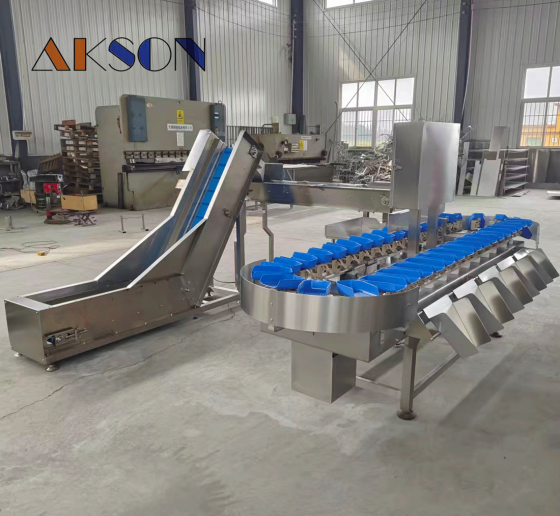

Better squid weight sorting processing: Qingdao Aikson’s weight sorter makes automatic sorting precise and efficient.
Grading squid is very important. It decides the product’s value and future quality. Different sizes mean different prices. They also affect drying, seasoning, and packaging. In the past, many factories used manual sorting. Workers judged size by eye and weighed by hand. That was slow and often wrong. Mixed grades were a common problem. This limited factory growth.
Now Qingdao Aikson Machinery Co., Ltd. changes this. The company started in 2015. It focuses on food machinery. Its belief: “innovation through technology, quality assurance.” AIKSON’s makes weighing sorting machines, weight sorters, grading scales, and auto feeders.
It has over 70 product types. AIKSON exports to more than 100 countries. It has a strong name in food machinery.
AIKSON’s squid juvenile weight sorter solves old problems. It uses two core technologies. First: automatic servo feeding. Second: intelligent dynamic weighing and sorting. These help seafood processors upgrade easily. Now you can move from “hand judging” to “fully automatic.”
Squid have irregular shapes. Their surfaces are slippery. Old belts push them hard. This causes stacking and sticking. Some even fall off. That hurts weighing accuracy.
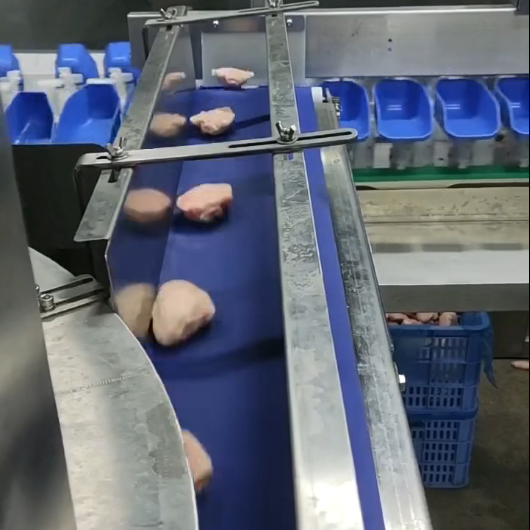
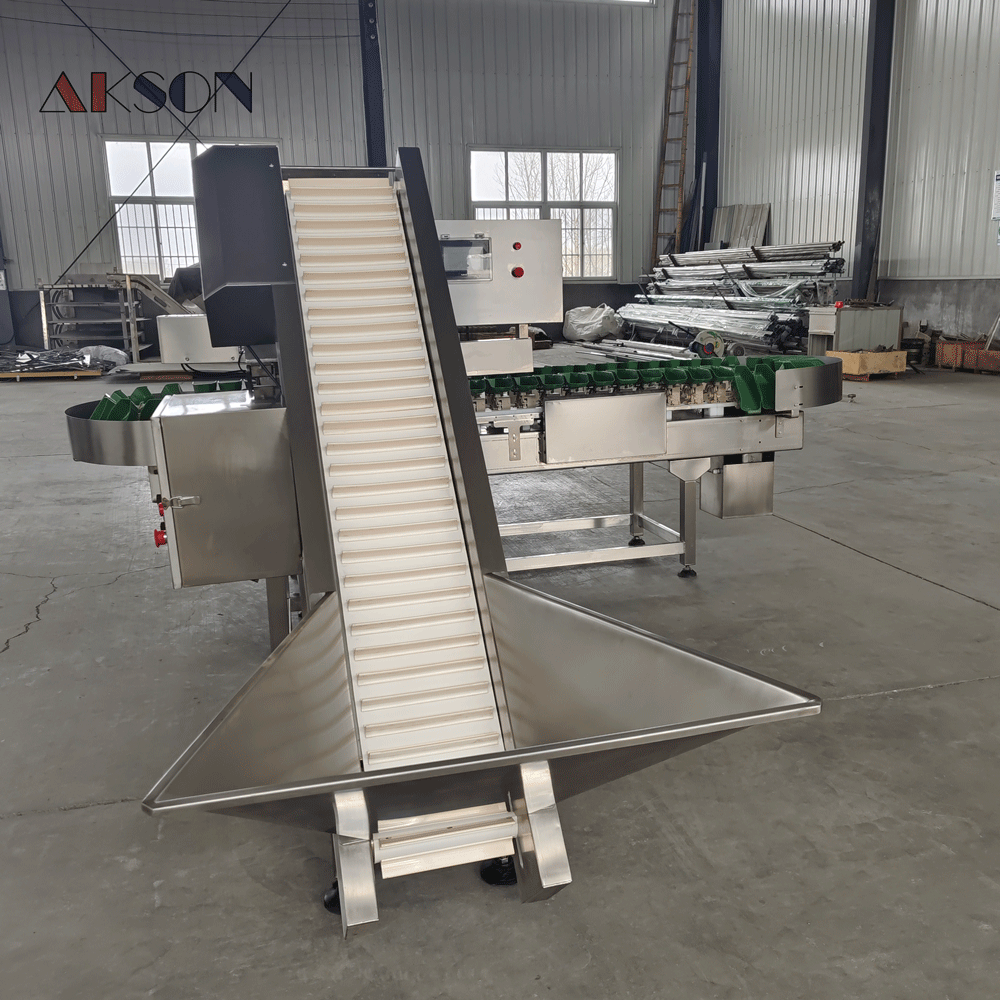
Qingdao AIKSON’s servo feeding system works differently. It sends each squid smoothly into the weighing area. They truly go in a queue and get weighed one by one.
Three simple steps:
Step 1: Lift the materials.
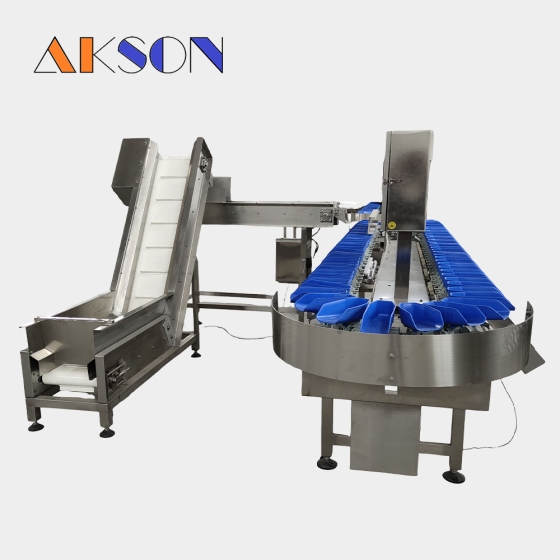
The operator pours cleaned squid into the elevator hopper. The machine moves them up slowly and steadily. This prevents damage from a big drop.
Step 2: Vibrate to spread them out.
The materials enter the vibrating feeder. The feeder vibrates at high frequency but small amplitude. Squid naturally spread into a single layer. You can adjust the vibration frequency. It depends on the size and moisture of the squid. If vibration is too fast, squid jump off the track. If too slow, they pile up.
Step 3: Feed with a servo belt.
This is the core of the system. The even layer of squid moves onto a narrow servo-driven belt. The servo motor gives precise speed control and fast response. The system reads feedback from the weighing module. It changes the belt speed in real time. When weighing is free, the belt speeds up. When weighing is busy, the belt slows down or stops. Flexible baffles or pneumatic paddles keep space between squid. This gives a solid base for accurate weighing.
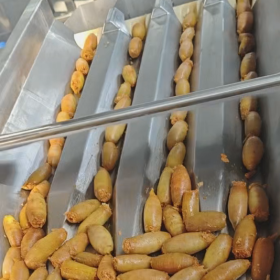
AUTO FEEDING MACHINE
II. Dynamic weighing and multi-level sorting: millisecond response, accurate to 0.3g
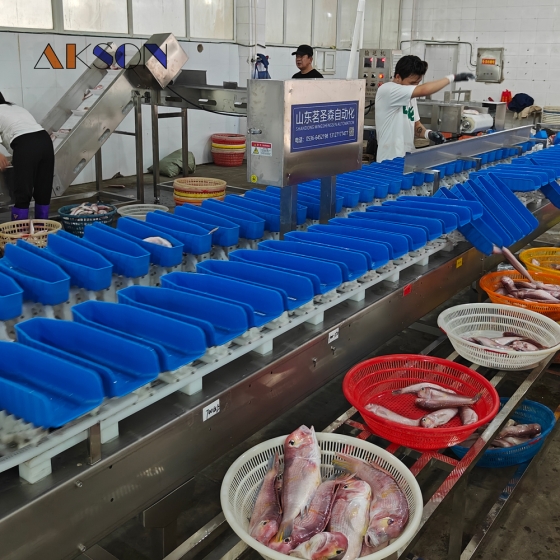
The feeding system sends in one squid at a time. Then the equipment shows its real strength. It performs high-speed dynamic weighing and multi-level sorting. The whole process takes only 0.1–0.3 seconds. That is tens of times faster than manual work. And it stays stable and reliable.
High-precision weighing Each squid passes through the weighing section. A high-precision sensor instantly captures its weight. Surface moisture can cause interference. Qingdao AIKSON’s machine solves this problem. It uses automatic zero-point tracking. It also has a temperature noise compensation system.
These features remove vibration and water film effects. The sorting machine processes 120–360 items per minute. Its sorting accuracy reaches ±0.5g. This meets strict factory requirements. One machine replaces 4–6 workers. It greatly improves efficiency. It also lowers labor costs.
Comparing weight to preset grades After weighing, the equipment compares the weight. It uses preset grade intervals.
For example: Below 5g → small, 5–10g → medium,10–15g → large, Above 15g → extra large.
Users can set these intervals freely.
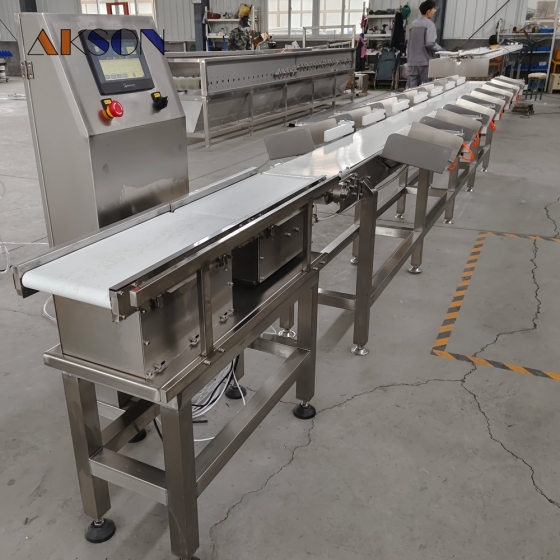
They use the 7‑inch&10-inch color touch screen. You can set 2 to 12 sorting levels. Operation is simple. The display is intuitive.
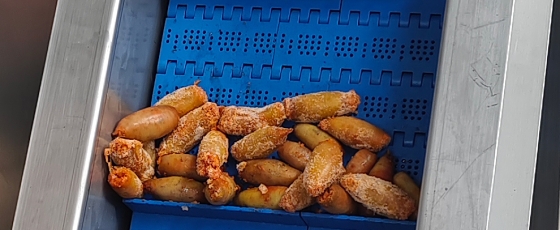
LIFTING MACHINE FEEDING FOR WEIGHT SORTING MACHINE